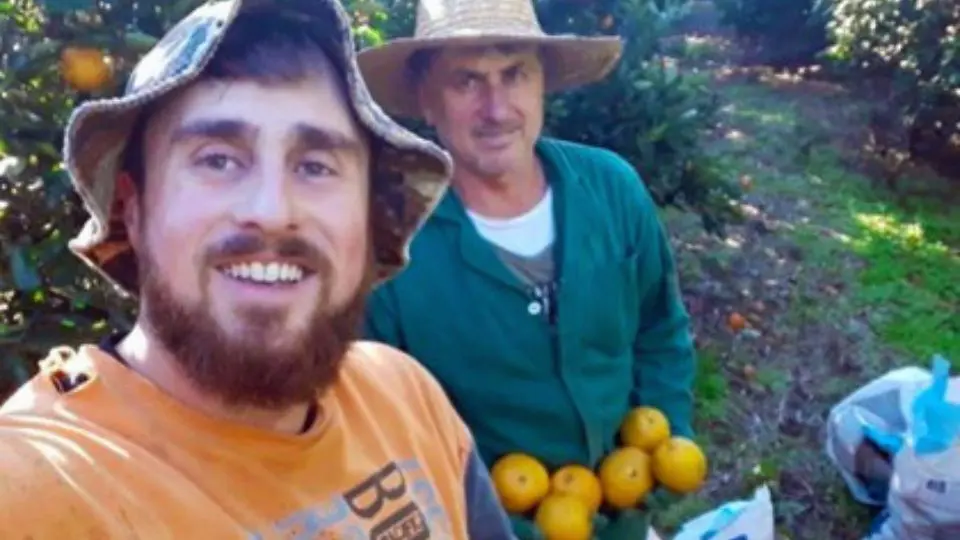
The Balbinotti family has been farming the same land in southern Brazil for five generations. When Ede Balbinotti's great-great-grandfather arrived from Italy and put down roots in the hilly interior of Rio Grande do Sul, the farm was built around survival.
Today, Ede: a young farmer with a degree in sustainable development, runs a 14-hectare mixed operation cultivating maize and oranges, alongside raising pigs. The crops have changed. The pressures have intensified. But his family commitment to the land remains unbroken.
"It's been five generations, since my great-great-grandfather to me.” Ede says. "We've always followed this path."
The farm has shifted and grown with each generation. His grandfather grew yerba mate: the bitter leaf tea beloved across southern South America, before switching to oranges as land, labour and markets rearranged themselves over the decades. Maize and pigs came to anchor the operation, corn feeding the animals through the year while the pigs in turn enriched the soil with organic matter.
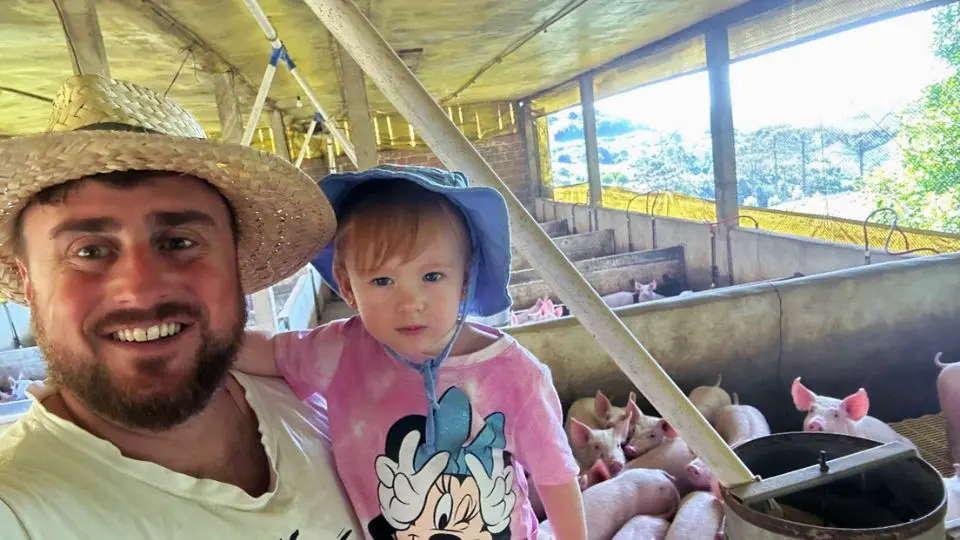
Figure 2 Ede Balbinotti with his daughter on the pig farm
What has changed most sharply in recent years is the climate. Rio Grande do Sul: Brazil's southernmost state and one of its most productive agricultural regions, has experienced increasingly erratic rainfall over the past decade. Droughts that came once in a generation now arrive almost seasonally.
“The extreme droughts in recent years have got us looking for new varieties that in addition to productivity, have better climatic adaptation; this is to ensure sufficient yielding in the face of adverse conditions” Ede Balbinotti
Ede's response has been methodical. Every year, he attends demonstration field days in his region. These are events where plant breeders present multiple different protected new varieties of maize side by side, each tested under local conditions. He watches which plants hold up when the rain is sparse, which recover fastest after stress. "We go to the field day, and you can often see which variety performs best” he explains. It is a practice his father never missed either, and one Ede has carried forward.
The results speak for themselves. In good years, when the weather aligns and the organic matter from his pig operation enriches the soil, Ede can harvest up to 12 tonnes of maize per hectare, a figure that places him well above Brazil's national average of around 5.7 tonnes per hectare according to Companhia Nacional de Abastecimento (CONAB, 2024)- Brazil's National Supply Company.
Ede has been buying certified seeds of protected varieties every year for 25 years. He explains that for his small diversified farm juggling pigs, oranges and maize across 14 hectares, producing and storing quality seed at home is not a viable option for him.

Drying, cleaning, treating and keeping seed vigorous requires storage, infrastructure and time that small farms simply do not have. "I can't just keep seeds at home," he says plainly. "I have no way to dry them, no way to clean them." What he can do is select well, invest in certified material, and extract maximum productivity from the land he has.
The same philosophy guides his citrus operation. With support from EMATER: the state agricultural extension service, and EMBRAPA: Brazil's federal agricultural research corporation, Ede sources grafted orange seedlings of Navel and Valencia varieties, chosen for vigour and disease resistance. He grows his oranges with minimal inputs, relying on organic treatments and the natural resilience of quality rootstock. "We were only able to achieve this because we also have high-quality plantlets," he notes. "If you start with a diseased plantlet, the plant won't yield, no matter what."
Brazil formalized its commitment to the system that enables this kind of innovation in 1999, when the country acceded to the International Convention for the Protection of New Varieties of Plants (UPOV Convention) — the international framework that underpins plant breeders' rights in 99 states worldwide.
Brazil's Plant Variety Protection Act had come into force two years earlier in 1997, establishing the legal foundation for breeders to invest in research knowing their work would be recognized and rewarded. The continuous pipeline of improved varieties that Ede selects from each season at demonstration plots is, in part, a downstream consequence of that policy choice.
For Ede, none of this is policy language. It is the simple arithmetic of keeping a fifth-generation farm productive in a climate that no longer behaves the way his grandfathers did.
The new varieties available to him today: more resilient, more productive under stress than anything his grandfather planted, are the reason the Balbinotti farm is still growing.
"Every year we hammer home the point: produce more with the same amount of land," he says. For him, the seeds of new protected varieties he buys are not a cost. They are the investment that makes everything else on the farm possible.