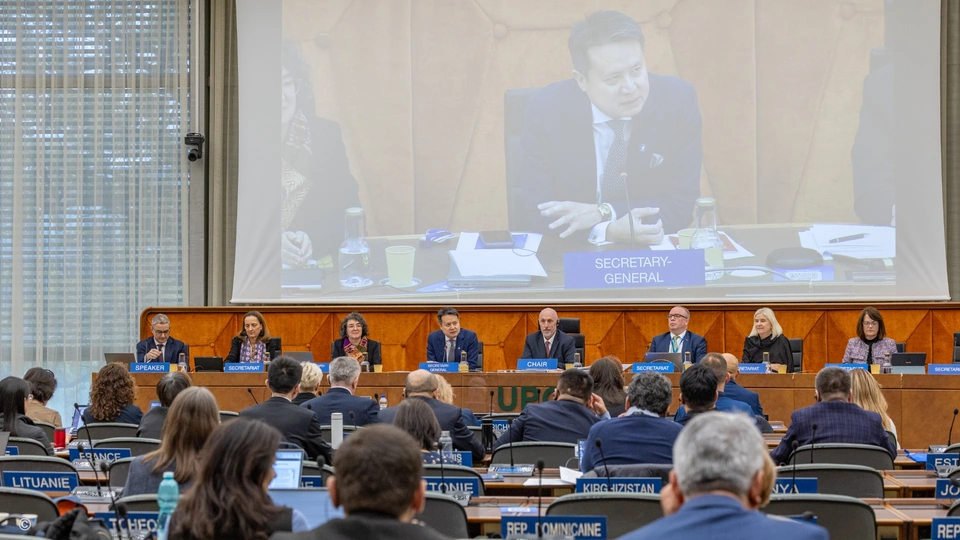
The 2026 UPOV sessions closed in Geneva on Friday, October 23, after a week in which members appointed Mr. Daren Tang to a second term as Secretary-General, welcomed a new observer organization from the Americas, and explored how protected varieties reach the people who grow our food, what opportunities they open up, and what remains to be improved.
Mr. Tang’s appointment runs to September 30, 2032, and follows his reappointment by the World Intellectual Property Organization (WIPO) General Assembly in April as Director General of WIPO.

Thanking the Council for the confidence UPOV members had placed in him and sharing his reflections, he described the UPOV community as special and close-knit , with a sense of camaraderie “increasingly lacking in many other parts of international fora.”
He attributed this to the nature of the subject matter. Agriculture, he said, “is really something that is key to the human experience, and the ability to innovate, invent and create depends first on being fed.” He also suggested that working with farmers, breeders and things that grow lends the community a practical outlook, since its members are “dealing with things that grow, that come out from the earth.”
The sessions brought together over 200 delegates from UPOV’s members, alongside observers from governments, intergovernmental organizations and stakeholders across the agricultural value chain, for five days of meetings beginning with the Technical Committee on Monday and concluding with the Council on Friday.
The week’s public highlight was the seminar “Bringing Innovation to Farmers: New Varieties, New Opportunities,” held on Wednesday afternoon and open to all interested parties. Bringing together farmers, breeders, policy makers and international organizations, it explored how innovation reaches farmers and growers ers through improved varieties and supportive policies.
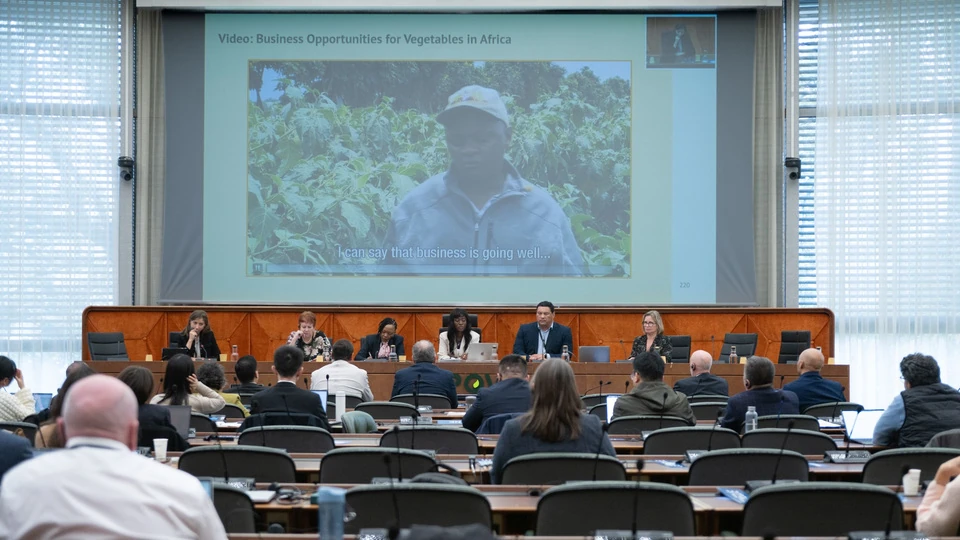
Speakers and panelists shared experiences from around the world. An Indigenous Chilean raspberry grower described expanding production and creating jobs through access to new varieties. The chief executive of a New Zealand kiwifruit collective set out the part new kiwi varieties has played in community development and in opening economic opportunities for Maori growers. From the United Republic of Tanzania came evidence of how plant variety protection and licensing have widened farmers’ access to drought resistance varieties.
Across the different crops and continents, a recurring theme emerged: innovation delivers the greatest benefits when policy-makers, breeders, farmers, and other actors across the value chain work together to ensure that new varieties reach those who need them most.
Building on last year’s seminar on cooperation with breeders in variety examination, the Technical Committee and the Administrative and Legal Committee reviewed progress on measures to increase cooperation in new plant variety examinations and the exchange of distinctness, uniformity and stability (DUS) test reports. Members received a report on three webinars held during the year, on environmental effects on the expression of characteristics, on the completeness and relevance of variety collections, and on phytosanitary delays that hold up access to plant material, and devoted an open discussion session to those same three questions.
The Technical Committee also saw a demonstration of a newly revamped web interface for the UPOV TG Template, the online tool used to draft Test Guidelines. Test guidelines tell examiners, crop by crop, which characteristics to observe and how to record them, and they are what allows a result produced by one UPOV member to be understood and relied upon by another. The template makes that drafting a shared process, giving experts standard wording to work from, a database of characteristics already approved in existing guidelines, and a dashboard tracking every draft and the comments on it. This is part of the new procedures applied across all UPOV Working Party sessions this year, with the aim of shortening the path from first draft to adopted guideline. Members also agreed measures to increase the support provided for UPOV members to draft their own national test guidelines, expanding the promotion of the development of new varieties of plants to a wider range of crops.
The Electronic Applications Meeting (EAM), held during the sessions, turned to the way applications are filed. Members discussed progress on the UPOV PRISMA Plus Project, an early-stage pilot launched earlier this year in response to UPOV’s Horizon Scanning exercise and its call for a system that is easier to navigate in an increasingly connected world. The pilot is exploring the identification of common core of PVP application data and terminology across participating authorities, while fully respecting national and regional procedures. Initial analysis suggests that up to 85 percent of application data could be reused, and the project is designed to support, rather than replace, existing national and regional systems.
The Administrative and Legal Committee continued its work on essentially derived varieties, a standing item since the Council adopted explanatory notes on the subject in 2023. Members and observers, including CIOPORA and the International Seed Federation, reported on putting that guidance into practice. Uruguay has introduced the concept into its legislation, a step led by the country’s National Seed Institute, INASE, and approved by Parliament. The discussion turned on how to make the 2023 guidance better known, both within the UPOV community and beyond.
On Friday, the Council adopted revised guidance on the number of growing cycles for variety examination, contributing to increased efficiency in growing trials. Members also approved an updated text of the WIPO/UPOV Agreement, first signed in 1982, subject to approval by the WIPO Coordination Committee next July, and elected new chairs for five Technical Working Parties.
The Union’s circle also widened. Members welcomed the Inter-American Association of Intellectual Property (ASIPI) as a new observer, supporting UPOV’s engagement with the intellectual property community across the Americas, and provided positive advice on the legislation of Suriname, bringing the country a step closer to membership.
Plant variety protection statistics presented during the sessions showed 33,850 applications filed worldwide by the end of 2025, a rise of 15.7 percent on the previous year and the tenth consecutive annual increase. Each one represents a new variety someone spent years developing, within a system that now counts 80 members covering 99 states.