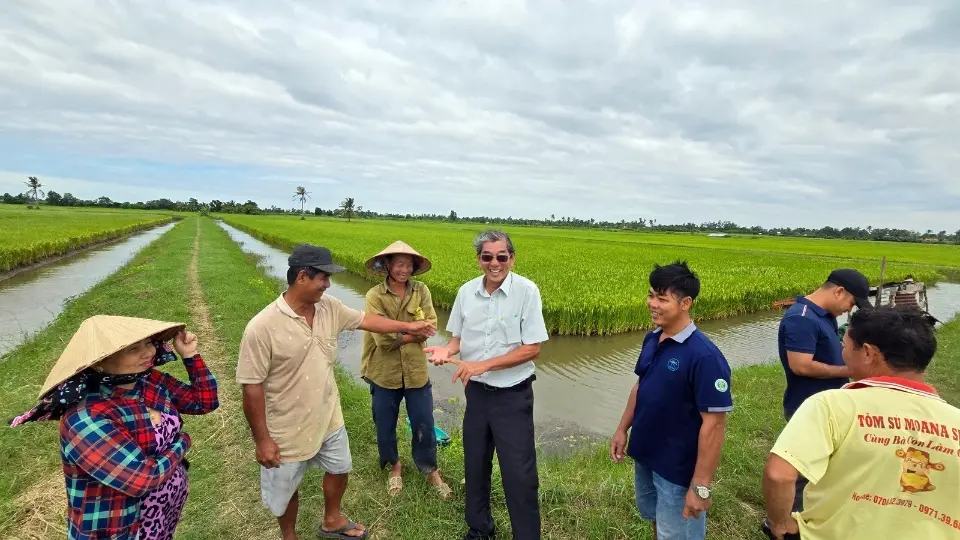
When ST25 won the World's Best Rice title at the 2019 World Rice Conference in the Philippines, it made history as the first Vietnamese rice variety to claim the top prize.
Behind ST25 is Hồ Quang Cua: an agronomist, and Hồ Quang Trí private enterprise established in 1990 in Sóc Trăng, a coastal province in the Mekong Delta. The company’s guiding principle coined by him states, “Improved Seed is a Catalyst of Prosperity.”
For Hồ Cua, seeds were leverage. “If the seed is weak,” he once told colleagues, “the farmer carries all the risk.”
The risk he was responding to was real.
In 1990s Viet Nam, the Mekong Delta was changing. Saltwater pushed further inland. Rice prices dipped and held low. During the dry season, many fields sat idle. The declining rice prices and limited dry-season income made agriculture an uncertain livelihood.
A shift began when researchers and policymakers reconsidered how land in brackish-water areas could be used. Between 1995 and 2002, projects supported by the Australian Centre for International Agricultural Research (ACIAR) examined integrated rice-shrimp farming systems.
The model allows shrimp cultivation during the dry season, when salinity levels are higher, and rice cultivation during the wet season.
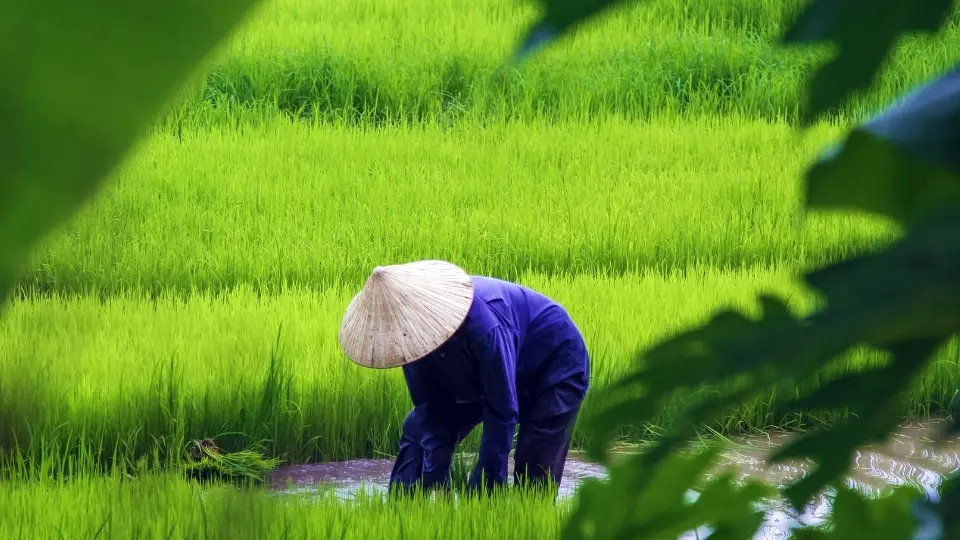
Figure 2 Viet Nam farmer on a rice paddy
New rice varieties capable of performing well under saline conditions were needed, and Hồ Cua set out to breed them.
“In the Mekong Delta, rice is a livelihood; it is the daily bread and the future of millions of farmers. We understand that just one better, more efficient rice variety can fundamentally transform the lives of these farmers. My vision was that Vietnamese rice could stand equal to the best in the world, and that Vietnamese farmers would get a better livelihood from their own fields.”- Hồ Quang Cua
What followed was two decades of incremental plant breeding. The ST lineage began in 1998 with ST1 and ST2, named in tribute to Hồ Cua's Sóc Trăng (ST) roots.
Each iteration addressed what the last could not. ST3 earned national recognition for its fragrance. ST20 won Vietnam's Best Rice Award in 2011. ST24 reached the podium at the World's Best Rice competition before ST25 claimed the title outright in 2019.

Developing a new rice variety is rarely the result of a single breakthrough; it is the outcome of years, often decades, of crossing, selection, field trials, and refinement. Each breeding cycle requires investment in research infrastructure, scientific expertise, and multi-season testing to ensure a variety is distinct, uniform, stable, and adapted to real farm conditions.
The ST lineage itself reflects this cumulative effort: from ST1 through more than 20 successive iterations, each was evaluated and refined before ST25 achieved its combination of fragrance, performance, and resilience.
In such a long and resource-intensive process, plant variety protection (PVP) provides essential legal and commercial certainty.
Viet Nam's membership to the International Union for the Protection of New Varieties of Plants (UPOV) in 2006 aligned national legislation with international standards, strengthening plant variety protection (PVP) across the country.
By granting breeders exclusive rights for new varieties, PVP enables them to recoup years of investment and reinvest in further research. According to the UPOV Plant Variety Database (PLUTO) plant variety rights for ST25 were granted in Viet Nam in March 2020.
Following the 2019 award, demand for ST25 surged in Viet Nam. The enterprise launched the consumer brand and trademark "Gạo Ông Cua" meaning Mr. Cua's Rice, to distinguish authentic products.
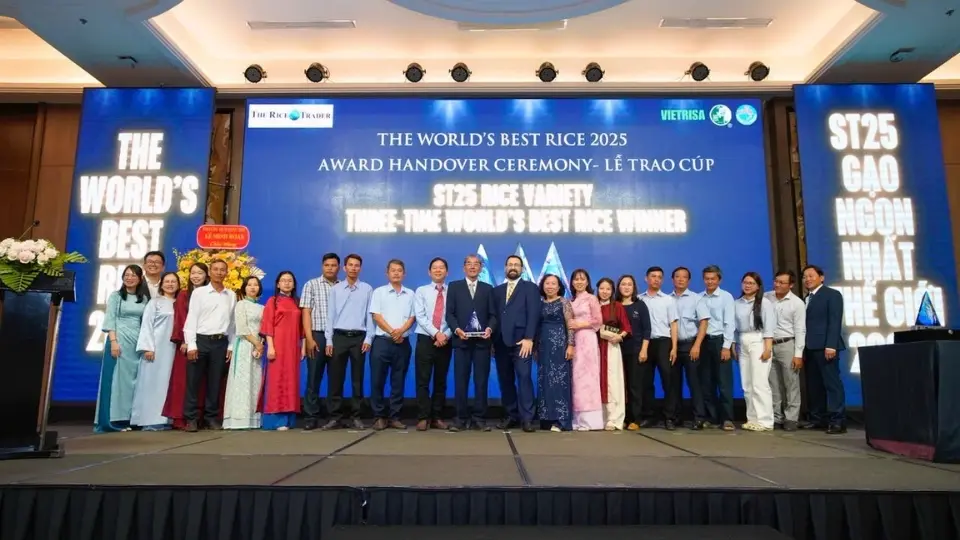
Figure 3 Staff and management of Hồ Cuang Tri receiving the 3rd consecutive award for the 'World's Best Rice.'
The Hồ Quang Trí enterprise today operates with a core research and engineering team of almost 50 people and around 150 employees in total. It works with more than 1,000 farmers through group leaders, supplying certified seeds, beneficial bacteria, and technical guidance while guaranteeing purchase of their harvest.
The enterprise also promotes practices compatible with rice-shrimp farming systems, including Alternate Wetting and Drying, which can reduce methane emissions by up to 50 percent and water use by approximately 30 percent compared to continuous flooding.
Media reports suggest that the protected varieties ST24 and ST25 are now estimated to contribute approximately US$88 million in incremental annual farmer revenue - a figure that reflects the economic impact plant breeding can have on farming communities
Mr. Trần Quang Vũ, son-in-law of Hồ Quang Cua and representative of the Gạo Ông Cua brand, describes what is now at stake:
"We are building on a foundation of trust that reaches from the muddy fields of the Mekong Delta to the kitchen tables of families across the globe. By protecting the ST25 legacy, we are protecting the livelihoods of thousands of farmers, the trust of our partners, and a profound sense of national pride that belongs to all of Viet Nam."
The wider picture reflects that ambition. According to the International Rice Research Institute (IRRI), Viet Nam has risen to become the second biggest exporter of jasmin rice, commanding nearly 40% of the global market share.
The Southeast Asian nation also boasts a historic 8 million tons of total rice exports in 2023 - worth $4.6 billion and the highest volume since 1969. (Source: Statista )
What began as a response to saline intrusion and rural vulnerability has since evolved into a case study in strategic agricultural development backed by effective plant variety protection. One that continues to unfold in the fields of the Mekong Delta.