It takes a particular kind of patience to develop a new plant variety. A plant breeder might wait years to taste the first fruit of a single cross, and sometimes, most of what they grow never earns a name.
Roland Joannin understands this better than most. The new variety he became known for took him seventeen years to develop. But before it was an apple, it was a word: 'Ó:iase' meaning "new apple" in Kanien'kéha, the language of the Mohawk, an Indigenous people of what is present day southern Ontario, Quebec and northern New York State.
Roland arrived in Quebec from France in 1982. He had spent his early career working with what is botanically known as stone fruit: cherries, peaches and nectarines, but it was the apple orchards of the Saint-Lawrence Valley that drew him in.
In 1986, he joined a small-scale non-profit breeding initiative in the community called La Pomme de Demain - French for "the apple of tomorrow", a cooperative of over 80 members united by a single ambition: to develop new varieties that would speak to evolving tastes and thrive in Quebec's challenging climate.
Over the years that followed, Roland and his colleagues evaluated more than 8,000 seedlings. The variety that would eventually become 'Ó:iase' began in 2007, taking seventeen years from first cross to the development of a new variety.
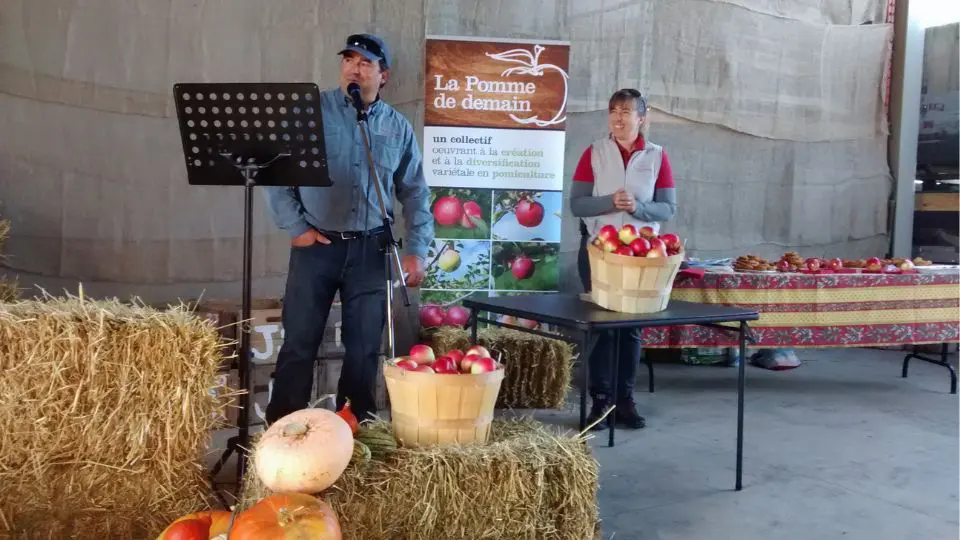
Figure 2: A 2014 La Pomme de Demain event showcasing the cooperative's new apple varieties.
When the time finally came to name it, Roland looked close to home. His test orchard sits in Saint-Joseph-du-Lac, a stone's throw from Kanehsatà:ke, the Mohawk community at the heart of the 1990 land conflict that Canadians still call the Oka Crisis. He had watched those events unfold, and the proximity had stayed with him. With a promising new variety in hand, he decided his apple would carry a Mohawk name.
The idea took shape after a conversation with friends who run a local Indigenous coffee-roasting business helped connect him with the Mohawk Language Custodian Association (MLCA), a non-profit dedicated to protecting and reviving Kanien'kéha, the Mohawk language.
There, he met Hilda Nicholas, the association's director who helped devise the name.
"When Roland first approached me, I was so pleasantly surprised," Hilda recalls. "I said to him, what a beautiful way to promote the language. To think of all the hard work and patience it takes to create a new apple, and then to honour us by giving it a name in Kanien'kéha. I was just so happy, and so honoured."
Hilda devised the name with care. The "Ó" signals a natural object, the colon marks a pause, and the syllables join the words for "apple" and "new." A new apple, and a new word in an ancient language. Simple, and yet it carries great meaning.
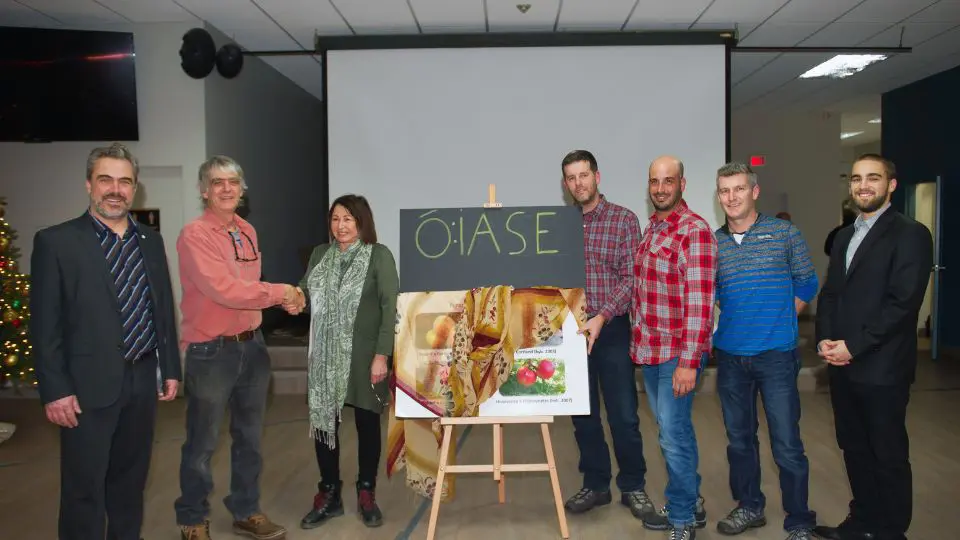
Figure 3: 2018, left to right: Nicolas Villeneuve, municipal councillor for Saint-Joseph-du-Lac; Roland Joannin, breeder at La Pomme de Demain; Hilda Nicholas, director of the Mohawk Language Custodian Association, Olivier Dumoulin president of La Pomme de Demain; board members Nicholas Lauzon and Sébastien Lavigne; and representative Danik Tondreau
For Roland, that is the whole point. The collaboration, he says, is a bridge between the region's farmers and the Kanehsatà:ke Mohawk community, between two histories that have not always sat easily side by side.
"For me, this was never only about the apple," Roland says. "Yes, it is a beautiful variety, and I am proud of it. But naming it in Kanien'kéha was a way to give something back, to build a relationship rather than just a product. ‘C'est un pont,’ a bridge. That matters as much to me as the fruit. "
Ó:iase' is still a young variety in commercial terms, but it is already gaining ground.
According to La Pomme de Demain, over 7,000 trees have been sold and planted in Quebec’s orchards, with the apples available seasonally at local stands where visitors can taste for themselves what seventeen years of work produced.
The variety's quiet advantage is timing: the fruit can be picked across the whole of October without losing quality, a real edge in an industry where a narrow harvest window can decide a season.
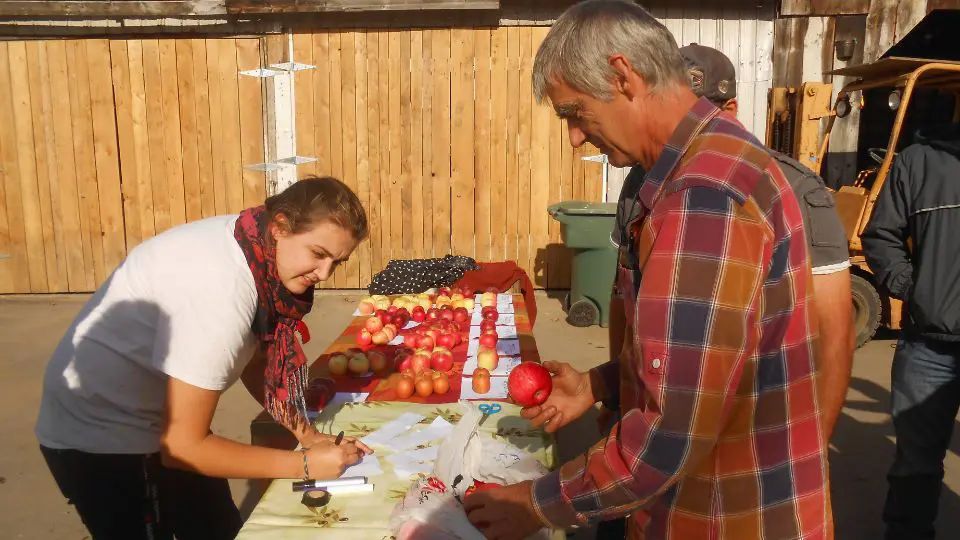
Figure 4: Roland presenting his apples
A good new variety is fragile, not in the orchard, but in the market. Without legal protection, anyone could propagate and sell 'Ó:iase' freely, and the years of investment behind it would never return to the people who bred and developed it.
That is where plant variety protection comes in. Through Canada's Plant Breeders' Rights (PBR) Office, part of the Canadian Food Inspection Agency (CFIA), 'Ó:iase' was confirmed to be new, distinct, uniform, and stable, and the cooperative was granted exclusive rights on November 1, 2024, allowing it to control how the variety is propagated and sold for up to 25 years.
Canada's PBR system runs under the international framework set by UPOV, the International Union for the Protection of New Varieties of Plants, which establishes the global standard that allows breeders' rights to function across borders.
The effect is measurable. After Canada amended its Plant Breeders' Rights Act in 2015 to align with the 1991 Act of the UPOV Convention, the country's Plant Breeders' Rights Office recorded a sustained rise in applications, with a notable jump in protection sought for fruit and vegetable varieties.
PBR protection is also what makes Roland's most personal gesture possible. In recognition of the collaboration that gave the apple its name, Roland pledged a portion of the royalties from every 'Ó:iase' tree sold back to the Mohawk Language Custodian Association, helping fund the immersion courses and education programs that keep Kanien'kéha alive.
"He's such a wonderful, kind man, he gives us a royalty from the sale of the apples each year, and that helps our nonprofit organization," Hilda says. "We are here in the community to protect, promote, revitalize and teach our language, our history and our culture. But there has never been funding for this kind of work, so we write many proposals to carry out our mission of revitalization."
So, each tree sold sends a small current in two directions at once: toward the breeders who made the apple, and toward a language reclaiming its ground.
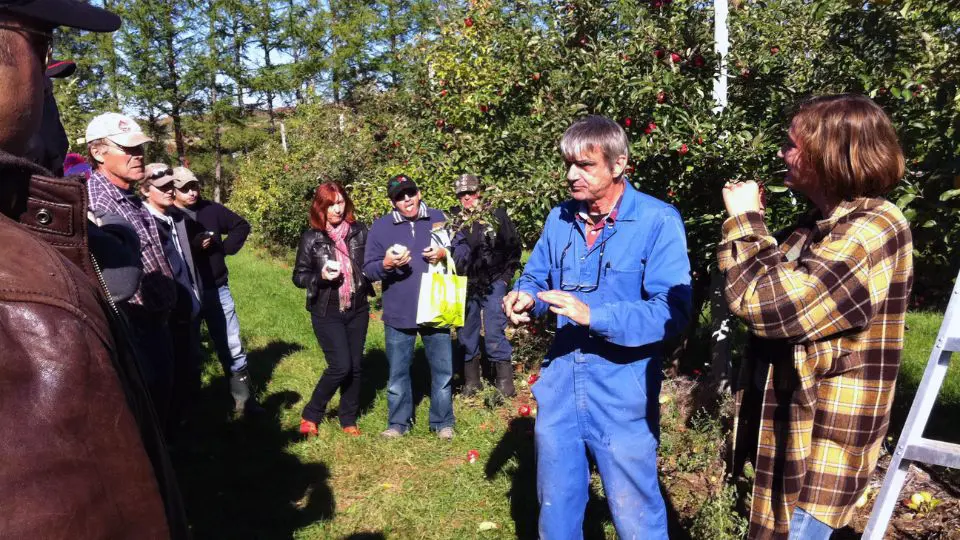
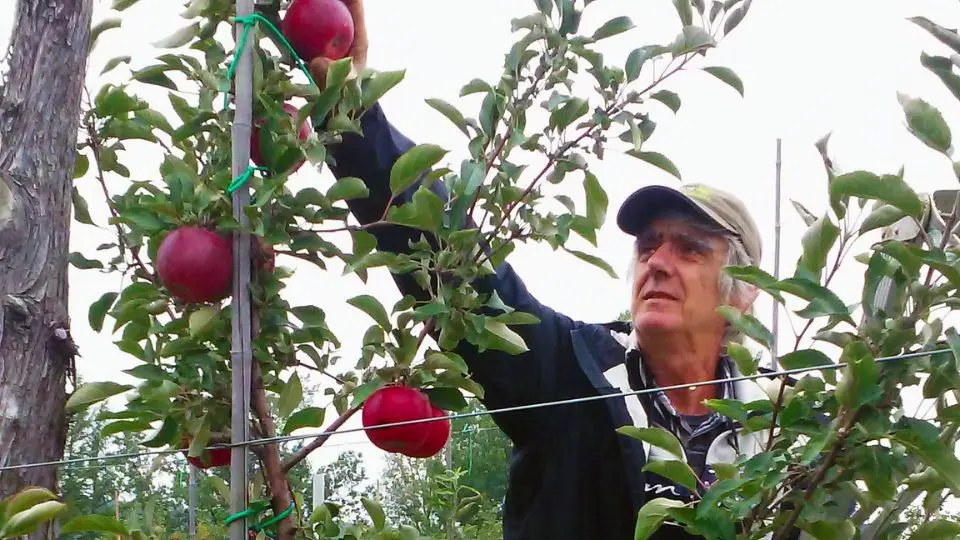
Figure 5: 2011: visits to the trial plots.
For now, 'Ó:iase' is taking root close to home, though Roland does not rule out other provinces, or even other countries, one day. Standing in his orchard with the foliage turning and the apples hanging red, the whole story comes into focus.
Seventeen years. More than 8,000 seedlings that came to nothing, and one that did not, carrying in its name a word that did not exist and a small act of repair between neighbours. It turns out that the right kind of patience grows far more than fruit.